 Biological Specimens Database
Data Capture
The starting point of data capture with BIODAT are insect collections which are deposited in traditional old cork-bottom insect drawers.
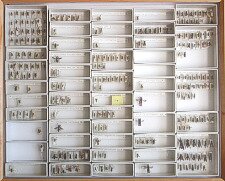
In our example, ants were transferred into a modern flexible unit tray system, which consists here of different sized cardboard boxes (photo right).
Thereby the taxonomic names are entered - after a validity check - into BIODAT thus establishing a taxonomic catalogue. Besides that, the drawer number which harbours specimens of the respective taxonomic unit is kept in BIODAT allowing quick access.
 Now a secondary data capture can take place by listing locations, collectors, determinators, etc. The list of locations/sites can be completed by adding geographic attributes such as latitude and longitude.
Next the data of the specimens were captured at the finest grained digitisation level as possible. Each specimen receives a BIODAT label and is transferred into plastic unit trays (example Chrysididae). As a result, the degree of digitization is even visible in the collection: material harboured in traditional old insect drawers is not digitized. Specimens deposited in cardboard boxes are digitized at the species level and those in plastic boxes at the specimen level.